
Panel responses - Navigating the music curriculum as a non-specialist
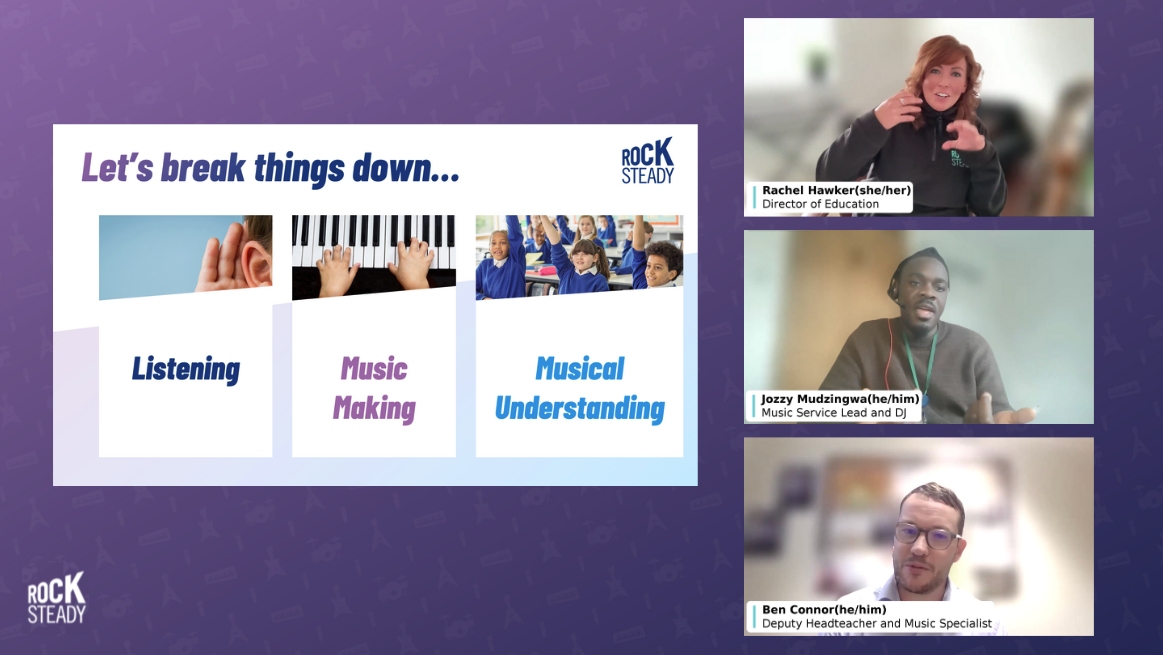
"You don't have to be a great musician to be a great teacher, you've just got to facilitate these discussions and this exploration."
Rachel Hawker, Director of Education
The below is a compilation of feedback, tips and additional guidance from our panel of experienced music educators from our webinar on the 2nd October: Jozzy Mudzingwa, Ben Connor, and Rachel Hawker. Their practical insights cover everything from using technology in the classroom to running successful school choirs, helping you bring meaningful music education to your pupils.
Using music technology for composition:
Bringing technology into music lessons can open up exciting possibilities, although many teachers feel unsure where to begin. Fortunately, there are multiple intuitive and accessible music-making platforms designed to support classroom creativity. Examples of these are:
- Soundtrap (by Spotify)
- BandLab for Education
- Launchpad (by Novation)
- GarageBand (Download for Mac or Apple App store here. Please note, this is for Apple products only.)
If you have tablets available in your classroom, these apps and programmes make recording and exporting incredibly simple as there is no other equipment required. You could even use QR codes so pupils can scan and listen back to their own creations – this is a great way for children to develop pride and ownership of their work.
If not, using a basic voice recording app to capture music-making works brilliantly for reflection and assessment.
Tip from Jozzy: “GarageBand is powerful but can feel complex at first, so I often recommend starting with Soundtrap or Launchpad as they feel more like apps than software, which helps build confidence before progressing to more advanced tools.”
Assessing musical progress:
In the current Ofsted framework, the emphasis for assessing musical progress is based on what children know and remember, rather than written records.
Therefore, the best assessment evidence is a well-designed curriculum that children can confidently talk about. To capture this, consider using audio or video recordings on a tablet, or encourage each class to maintain a ‘Music Big Book’ - a collection of prompts and reflections to help children recall what they’ve learned. These resources can be brought into meetings with Ofsted, or used by the children themselves to talk about their musical learning with confidence.
As this is mostly verbal, the only written work should be notations such as visual symbols that represent sounds, instruments or actions, or letters to represent musical notes.
Tip from Ben: “At my school, we use a tracking software called ‘Insights’. This has statements from our music Scheme of Work, and we use it to assess each lesson.”
Structuring your music lessons:
We know how busy the school week is, therefore introducing a weekly 30-minute music lesson is a brilliant starting point to bring more music into your classroom. This creates space for pupils to explore sounds and express their creativity.
It’s important to make that half an hour count by having resources and lesson plans ready. A great way to structure your lessons is by beginning with listening and understanding, then encouraging improvisation and experimentation, and finally moving into composition and performance.
This mix keeps lessons creative, balanced, and aligned with curriculum expectations.
Tip from Jozzy: “I recommend maintaining momentum with short 10-15-minute sound exploration activities between formal lessons, such as quick “DJ warm-ups” or rhythm challenges.”
Tip from Ben: “I tend to teach six units in a year, each focusing on a particular genre or style of music. Within those lessons, all composition starts with improvisation. Perhaps give pupils a limited number of notes to play with and ask them to mix these together. From this, draw out a simple composition, and then build the complexity.”
Good to know basic music vocabulary:
In the National Curriculum for Music for Key Stages 1 and 2, the “inter-related dimensions of music” are the core elements through which music is understood, performed and created. These include:
- Pitch: how high or low sounds are.
- Duration: the length of notes and sounds (including rhythm).
- Dynamics: how loud or quiet the music is.
- Tempo: the speed of the music.
- Timbre: the quality of the sound that makes it different to other sounds (e.g. different instruments or voices).
- Texture: how many sounds are heard together (e.g. solo, unison, harmony).
- Structure: how the music is organised (e.g. verse/chorus, repetition, contrast).
Songs to teach musical terms
Introducing musical terminology using modern and relatable songs is a fantastic way to keep pupils engaged. With that in mind, here are some brilliant song suggestions from Rachel that you can bring into your lessons:
- Pitch – Any song or piece of music can convey pitch. A good, contemporary example of this is ‘Golden’ from K-Pop Demon Hunters – the verses are low-pitched with a jump to a high-pitched vocal in the chorus. With its recent popularity, children will also immediately be able to relate to the narrative and songs from the movie.
- Tempo – Try playing a game called ‘Tap That Tempo’ using different genres of music. Demonstrate a slow tempo with ‘Tortoises’ from Carnival of the Animals, mid-tempo with ‘Count on Me’ by Bruno Mars and fast tempo with ‘Cotton Eyed Joe’. You can make this an engaging game by asking pupils if the previous track was slower or faster.
- Dynamics – ‘It’s Oh So Quiet’ is a great song to start teaching dynamics as it has obvious changes. You can get children walking around on tiptoes during the verses, and then stroll around the room boldly when the chorus comes in. You can then foster conversations around which instruments were heard in the quiet section and which instruments come in for the louder section.
Tip from Rachel: "Try 'Musical Word of the Week' as a 5-minute filler in your lesson. For example, introduce dynamics and ask children what they already know about it. You can also play a guessing game like the party game where you have a post-it note on your head with a celebrity—but use musical terms like 'tempo' instead. The other children have to explain what tempo is without saying the word."
Fun warm-up activities to start your lessons with:
Rachel says "We have a great range of resources that can be used in the classroom, either as part of a lesson plan or as a musical warm-up. I developed these and my team host them, so sign up for our existing resources now and keep an eye out for more content from us soon:
- Beat Masters – Introduce children to one of music’s most essential building blocks – the beat! Download Beat Masters
- Higher or Lower - Familiarise pupils with the concept of high and low-pitched sounds. Get Higher or Lower"
Instruments in the classroom:
If you're looking to introduce some basic instruments into the classroom, starting with a mix of pitched and unpitched percussion is a great way to begin exploring practical music-making. Instruments like glockenspiels can help demonstrate pitch, while claves, shakers, tambourines, and djembes are excellent for teaching beat and rhythm.
Rachal says "While having a variety of instruments is beneficial, it's not always feasible. Fortunately, effective music teaching doesn't rely solely on having a wide selection of instruments. The key is to embrace a range of creative approaches that make music accessible to all pupils."
"High-quality lessons can still be delivered with limited resources by using voices, body percussion, and digital tools to explore key musical concepts."
Funding support opportunities:
If you are looking for music funding support in your school, there are a variety of opportunities you can explore:
- Music for All (a national charity supporting school instrument funding)
- Awards for All (The National Lottery Community Fund)
- Youth Music
- Local community music hubs that provide equipment loans and partnership projects.
Music-making with electronic instruments:
For those who feel more comfortable using electronic instruments in lessons, Jozzy has some fantastic tips on how to use DJ decks to teach musical concepts:
“DJ decks are a legitimate musical instrument in their own right; they simply fall into the category of electronic and digital instruments. When pupils use decks, they develop key musical skills such as listening and responding to rhythm, tempo, pitch, and structure. They can also create and perform through beat-matching, looping, and layering, as well as compose and improvise by manipulating sound and structure. Choosing samples, effects and transitions are all acts of creative decision-making.
“In my past sessions, I’ve focused on developing musical understanding through performance and composition. Building sets, editing transitions, and creating remixes are all compositional processes.
“The National Curriculum doesn’t restrict how music is made, only that pupils should create, perform, listen, and evaluate - and DJing hits all four of these areas perfectly!”
Fostering a love for music through school choirs:
Want to inspire a love for music through singing? Ben has some great insights into successfully running a school choir and getting the most out of young voices:
“I hold choir sessions once a week for 45 minutes after school. We started with small numbers of only 6 or 7 pupils, but I make sure as a choir we get out and sing. We perform at the local Christmas markets and every couple of years I take my choir to Young Voices. When it's a Young Voices year, choir numbers shoot up as children want to take part, and then some stay because they enjoy it.
“I always have fun warm up and cool down games (Tony Chestnut, the Penguin Song, Cold Spaghetti) which the children love. The best thing to do is find a range of songs written for children that are easier to sing and learn, rather than singing modern pop songs which are often hard. It all starts with getting the children to understand the parts of their bodies which are important for singing, such as vocal folds and diaphragm.”
Check out Ben’s article for TeachPrimary, where he shares singing techniques and video demonstrations - Ben Connor, Author at Teachwire.